What is Serial and Parallel Communication?
What is Parallel Communication?
Parallel communication - parallel data transmission is the sending of the bits in data simultaneously. In parallel data transmission, there is a separate cable for each bit of the data used, and each bit is transmitted through a separate cable.
In parallel input/output, communication is carried out over 11 cables/wires: 8 bits of data, 1 bit data ready, 1 bit data request, and 1 bit GND.
Parallel communication happens quickly, but since a separate cable/wire is used for each bit, it is a costly method.
If we need to give an example for parallel communication, I cannot give many examples from today's computers, but the DB25 port found in old computers would be a good example of parallel communication.
A small note: The DB25 port is the port used to connect old computers to printers.
What is Serial Communication?
Serial communication is a communication protocol in which all data are transmitted over a single wire/cable. Since data is transferred over a single cable in serial communication, it is slower than parallel communication but is a lower-cost method.
In serial communication, communication is carried out over 2 cables/wires: 1 data and 1 GND.
Communication on the computer is provided by serial communication. In serial communication, only one bit of a character is transmitted at a time. Therefore, for proper communication with the receiving machine, the receiving machine needs to know the character length, start/stop bits, and transmission speed.
Since all bits are sent at the same time in parallel transmission, there is no need for start/stop bits, whereas in serial transmission, since all bits go over a single line, this is needed.
If we need to give examples for serial communication, the USB, Ethernet, and RS232 ports found on computers can be given as examples.
Serial communication is divided into two types: Asynchronous and Synchronous.
Asynchronous Communication
This is a type of communication where it is not necessary for the receiver and transmitter to operate simultaneously. When there is no data transfer, the line remains idle. It is slower compared to synchronous communication.
Each data group is sent separately, and at any given time only one character is put on the line to be transmitted.
A start bit is placed at the beginning and another bit is placed at the end of the character to detect possible errors. The start bit (0) is used to initiate the communication, and the stop bit (1) is used to terminate the communication.
Synchronous Communication
This means that the receiver and transmitter operate simultaneously. First, the sender transmits a specific character, which is a start of communication character known by both sides; when the receiver reads this character, communication begins.
After communication starts, the sender begins to send data and the data transfer continues until the process block is completed or the communication is terminated.
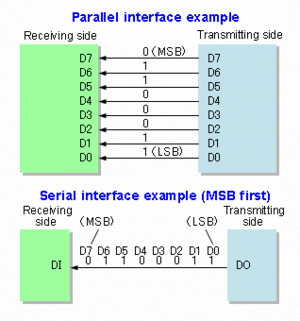
This image may be the best to explain serial and parallel communication; the upper part is parallel communication, and the lower is an example of serial communication.
Differences Between Serial Communication and Parallel Communication
- Parallel communication transmits data faster than serial communication.
- Parallel communication is more costly compared to serial communication.
- Parallel communication requires more physical space compared to serial communication. (Because more wires are used, as the number of wires increases, the need for physical space also increases.)
- There is no need for start/stop bits in parallel communication. (Because data is transferred simultaneously.)
- In parallel communication, each bit is sent over a single wire/line, whereas in serial communication all data is transmitted over the same wire/line.
- Start/stop bits are used in serial communication.
- The transmission speed must be known in serial communication.


Yorum Gönder